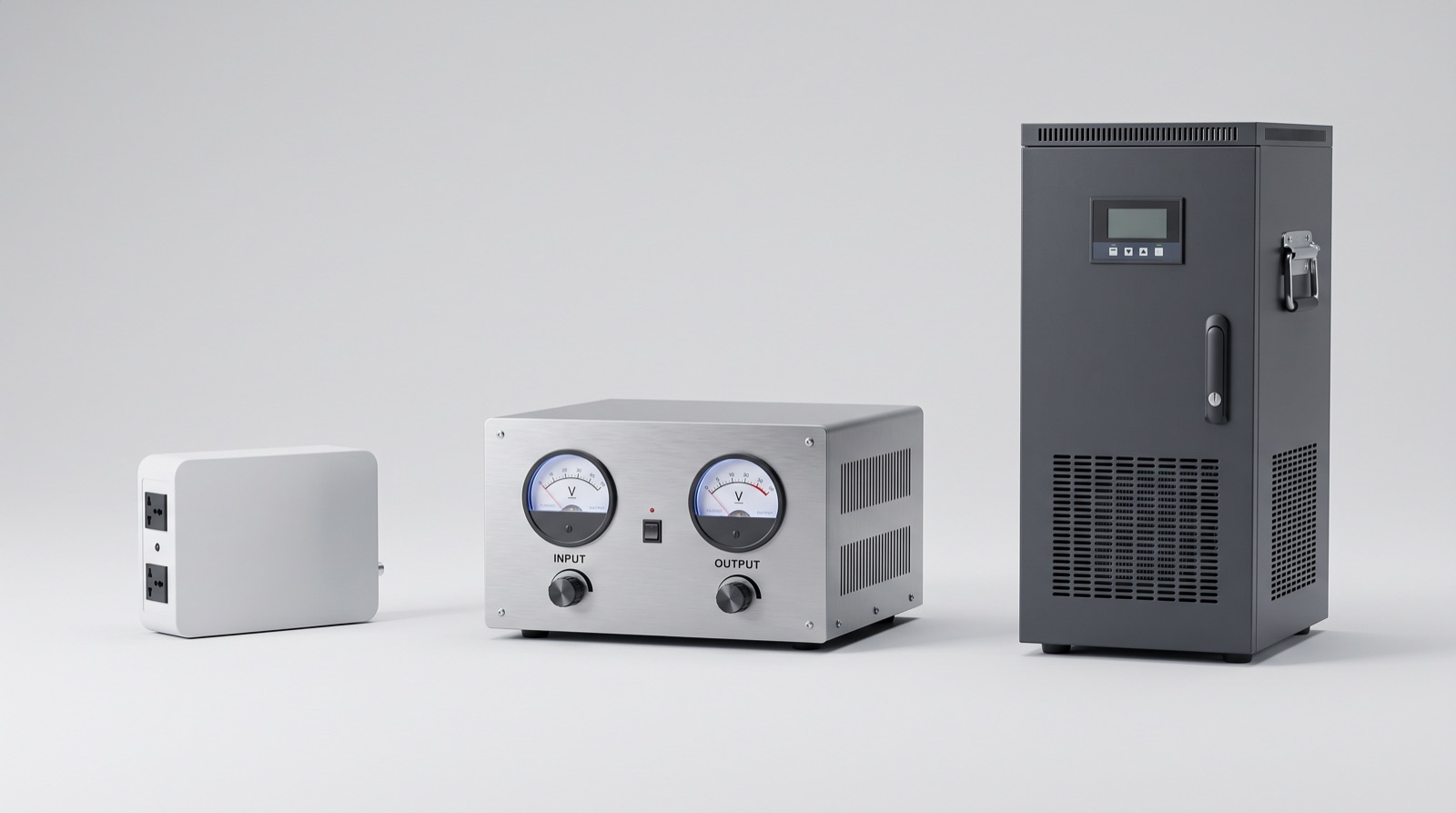
Most stabilizers in Pakistani homes are the cheap relay type. But there are three kinds, and the difference matters for your appliances and your bill. Here it is in plain words.
Relay (AVR) — the cheap "local" stabilizer
This is what most shops sell by default. It switches voltage in fixed steps, so the output jumps up and down (±5–10%). You hear a click every time it corrects. It is the cheapest to buy, but it wastes the most power and the relay contacts wear out fastest. Fine for one small appliance on a budget.
Servo (SVC) — the motor type
A small motor drags a carbon brush along a winding to correct voltage smoothly (±1%). It is good for motor loads. But it has moving parts — the motor and brush wear out over time and need service, and it makes a faint hum.
Inverter (IGBT) — the newest type
This works like an inverter AC. It rebuilds the power electronically and corrects voltage instantly (0 ms) with no moving parts. It runs silent, needs no maintenance, gives a clean pure sine output, and is over 96% efficient — so it wastes the least power. It costs more up front but pays you back on the bill and lasts longer.
For a modern home with inverter ACs and sensitive electronics, the inverter (IGBT) stabilizer is the best choice. For one budget appliance, a relay AVR is enough.