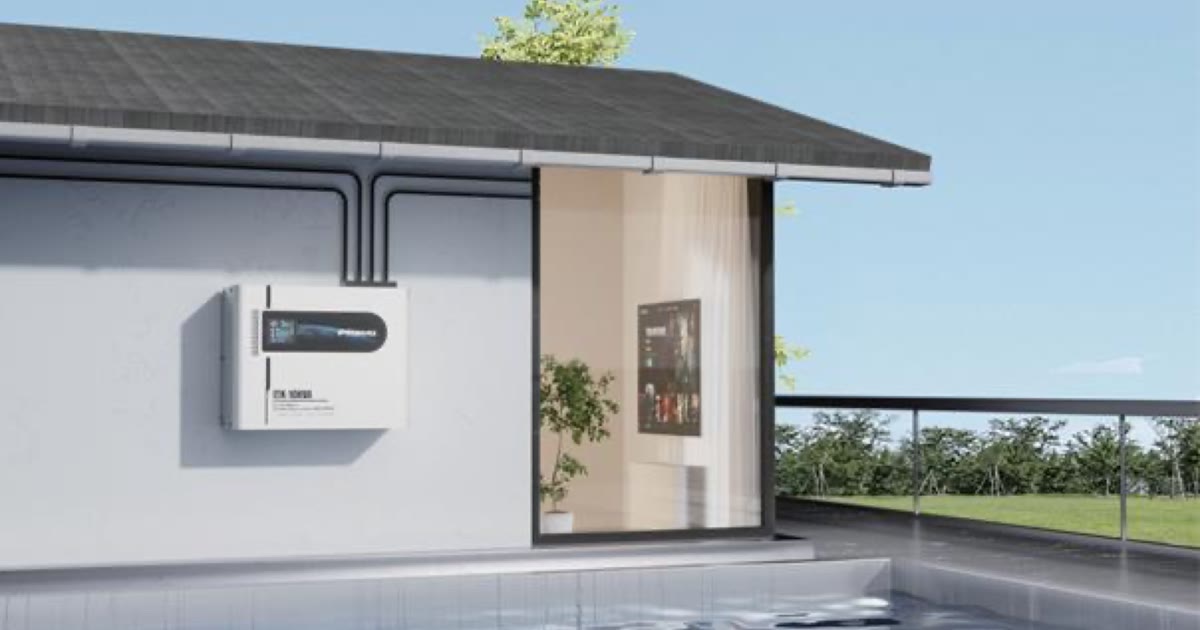

Pakistan already made this switch once. Ten years ago most ACs were fixed-speed. Now most new ones are inverter ACs. The chip that made that possible is called an IGBT. It also runs your solar inverter. And it is now doing the same thing to voltage stabilizers.
Here is how an IGBT (inverter) stabilizer compares with the servo (SVC) stabilizer most homes and shops use today — honestly, including where the servo still wins.
How each one fixes voltage
Servo: a small motor drags a carbon brush along a copper winding. The further it moves, the more the voltage changes. Smooth, accurate — and limited by how fast the motor can turn.
IGBT: a control chip measures the incoming wave all the time. IGBT switches turn on and off tens of thousands of times a second to add or remove exactly the voltage needed. Filters smooth that into a clean 220V sine wave. Nothing moves to do the correcting.
Side by side
| Servo (SVC) | IGBT (inverter) | |
|---|---|---|
| What does the correcting | Motor and carbon brush | IGBT switches and a control chip |
| Response | About 25–30 V per second | 0 ms rated |
| Holds 220V from (Voltec) | 100–280V on the 10 kVA, choose your range | 90–310V on every model |
| Output accuracy | ±1%, once it catches up | ±2%, all the time |
| Wave shape | Passes the mains wave through, distortion included | Pure sine, distortion under 3% |
| Efficiency | >96% | ≥96% |
| Weight (10 kVA) | Heavy transformer cabinet | 12.7 kg, wall-mounted |
| Noise | Motor hum | Silent; fan runs when warm |
| Upkeep | Brush and motor checks | Keep the vents clear |
| Price | Lower up front | Higher up front |
| Sizes (Voltec) | 1–30 kVA single-phase, up to 500 kVA three-phase | 550VA–20 kVA single-phase |
Why speed matters more than the last 1%
On paper, a servo's ±1% looks better than an IGBT's ±2%. But that ±1% only applies after the motor has caught up. When the voltage drops suddenly from 220V to 160V, a servo turning at about 28 volts per second needs around two seconds to get back. During those two seconds, your equipment gets far worse than ±1%.
An IGBT never falls behind. It corrects within the wave, so the output stays inside ±2% the whole time. For an inverter AC's control board, a laser, a computer or a lab analyser, those two seconds are what cause a reset, an error or damage. That is the real difference.
Wave quality: the part nobody talks about
A servo is a transformer. It changes the size of the voltage, but it passes along the shape of the wave exactly as it arrives — including the distortion from UPS chargers, inverters and motors on your street.
An IGBT stabilizer builds a fresh wave. The Voltec range gives a pure sine with distortion under 3%. Inverter AC compressors, LED drivers, medical devices and audio equipment all run cooler and cleaner on a clean wave.
The 90V question
In many parts of Pakistan — the end of long feeders in South Punjab, interior Sindh and the villages of KP — evening voltage falls to 100–150V, and sometimes lower. Late at night, when the load drops, it can jump above 260V.
The Voltec IGBT range holds 220V from 90V up to 310V on every model, with no special order. A servo can be built for low voltage too, but you have to choose that range when you order. If you are not sure how low your voltage goes, the IGBT is the safer pick.
Is the bill lower?
A little, but do not buy it for that. Both types are around 96% efficient. The IGBT has no motor to run, and holding a steady 220V keeps your AC and fridge working at their rated efficiency. That saving is real but small. Buy an IGBT for protection and no upkeep — the bill is a bonus. More on this in will an inverter stabilizer lower your bill.
Where servo still makes sense
- Tight budget. A servo costs less up front for the same kVA.
- Above 20 kVA, or three-phase. Servo gives the most kVA for the money at large sizes. Our three-phase systems come in servo or static IGBT.
- Heavy motor starts. A big transformer shrugs off a large starting surge. An IGBT can handle motors too, but must be sized with more headroom.
- A healthy servo you already own. Keep it until it starts costing you service visits.
Sizing an IGBT stabilizer
Electronics have less overload margin than a big lump of copper and iron, so size with care. Inverter ACs start gently. Fixed-speed ACs, fridges and water pumps pull a surge at start-up, so leave more room.
| Voltec IGBT model | Rated current | Typical use |
|---|---|---|
| 550VA | 2.5A | TV, router and a few lights |
| 2 kVA | 10A | One AC, or a room of electronics |
| 5 kVA | 25A | One or two ACs plus fridge, fans and lights |
| 10 kVA | 50A | A full home with several ACs |
| 15 kVA | 75A | Whole home or small shop, geyser and motors included |
| 20 kVA | 100A | A large home or shop load |
Send us your appliance list or a photo of your AC and pump nameplates, and we will size it for you. See also what size stabilizer your home needs.
Our honest view
We sell both. For a home with inverter ACs, a clinic, or a workshop with sensitive machines, the IGBT is where the market is going — the same way the inverter AC took over from the fixed-speed one. For large and three-phase loads, servo still earns its place. Read the full picture in our guide to solid-state stabilizers.