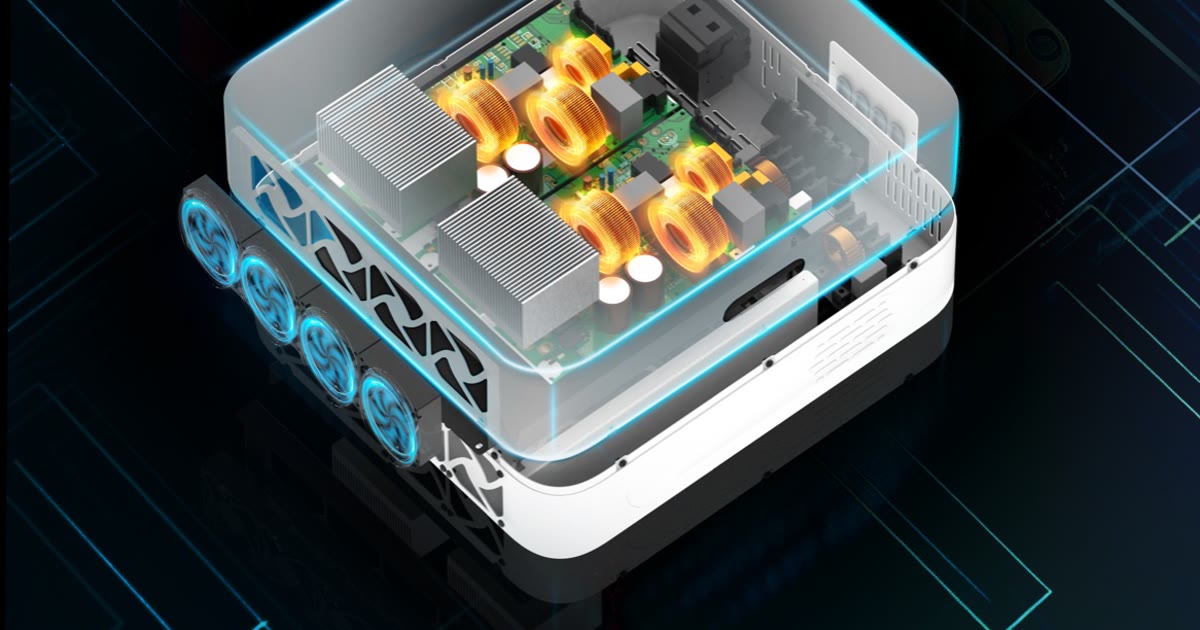

For forty years, Pakistani homes have protected their appliances with two kinds of stabilizer. The relay type, which clicks. And the servo type, which hums. Both work. But both fix your voltage by moving something — and anything that moves, wears out.
A newer kind of stabilizer does the same job with no moving parts in the correction at all. It is called solid-state, or static. It comes in two types: SCR (thyristor) and IGBT (inverter). This guide explains both in plain words, where they win, where they do not, and how to choose.
Four types of stabilizer, two families
| Type | How it fixes voltage | Moving parts | Speed | Output |
|---|---|---|---|---|
| Relay (AVR) | Relays click between transformer taps | Relay contacts | Stepped, under a second | Steps of ±5–10% |
| Servo (SVC) | A motor drags a carbon brush along a copper winding | Motor, gears, carbon brush | About 25–30 volts per second | 220V ±1%, smooth |
| SCR (thyristor) | Silicon switches pick the right transformer tap | None in the correction | About 20 ms | 220V ±5%, stepped |
| IGBT (inverter) | Fast silicon switches build the correct wave | None in the correction | 0 ms rated | 220V ±2%, pure sine |
The servo, SCR and IGBT figures are from the data sheets of the ranges Voltec sells. The first two types are electro-mechanical. The last two are solid-state.
Why moving parts are the problem
They wear. Every time a relay clicks, a small spark eats into its contacts. Every time a servo corrects, its carbon brush rubs along the winding. In Pakistan the voltage moves all day, so a stabilizer corrects thousands of times a month. Contacts pit. Brushes wear down to the spring.
Dust and heat make it worse. Summers above 45°C dry out motor grease. Dust settles on the brush track and in the gears. A servo even makes its own dust: its brush sheds carbon as it wears. A sealed silicon switch does not care about any of it. More in why dust is a servo's enemy.
A motor is slow. This is the one most people miss. A servo motor can only turn so fast. Our own servo units correct at about 25–30 volts per second. So when the voltage suddenly falls from 220V to 160V, a servo needs about two seconds to catch up. For those two seconds, your appliance sees low voltage. A solid-state stabilizer reacts within one cycle of the mains — 20 milliseconds — or faster.
They make noise. Relays click. Servo motors hum. Solid-state units are silent apart from a cooling fan that runs when they get warm.
We have seen this change before
Think about what happened to air-conditioners. Ten years ago, most ACs in Pakistan were fixed-speed. Today, most new ACs sold are inverter ACs. The old type was cheaper at first. The new type won because it does the job better and wastes less.
The same thing happened to TVs (tube to LED), to computer storage (spinning disk to SSD) and to electricity meters (spinning disc to digital). Each time, the mechanical version was replaced by a solid-state one. Silicon power switches are now cheap and reliable enough to do the same to stabilizers. In fact, an IGBT stabilizer uses the same family of power chip that runs your inverter AC and your solar inverter.
SCR: solid-state at a sensible price
An SCR stabilizer has a transformer with several taps, like a relay stabilizer. The difference is the switch. Instead of a metal relay that snaps open and shut, it uses thyristors — silicon switches with no contacts. They switch at the moment the AC wave crosses zero, so there is no spark, no click and nothing to burn.
The Voltec SCR range holds 220V ±5% across a 95–250V input (it keeps working from 85V to 268V), corrects in about 20 ms, is ≥95% efficient, and has six layers of protection. It suits laser machines, clinic devices, ultrasound, electronics, and homes and shops where speed and long life matter and ±5% is enough. More: what an SCR stabilizer is and SCR vs servo, side by side.
IGBT: the top of the range
An IGBT stabilizer does not pick a tap. It measures the incoming wave and switches IGBT chips tens of thousands of times a second to build exactly the voltage you need. Filters smooth that into a clean sine wave.
The Voltec IGBT range holds 220V ±2% across a 90–310V input, has a 0 ms rated response, gives a pure sine output (distortion under 3%) and is ≥96% efficient. Because it switches at high frequency, it needs much less iron: the 10 kVA model weighs 12.7 kg and hangs on a wall. It suits the most sensitive machines, inverter ACs, whole homes in very-low-voltage areas, and anyone who wants the cleanest power. More: what an IGBT stabilizer is and IGBT vs servo, side by side.
Where servo and relay still make sense
We sell servo and relay stabilizers too, so here is the honest picture. They are not going away tomorrow.
- Very large and three-phase loads. At 100 kVA and above, a servo still gives the most kVA for the money and takes heavy motor starts well. Our three-phase industrial systems come in servo or static IGBT, made to your load.
- One appliance on a tight budget. A relay AVR is the cheapest honest protection for a single fridge or AC.
- A servo that is working well. If yours is healthy and your load is ordinary home appliances, keep it. Replace it when it starts to cost you service visits.
So our rule is simple. For homes, shops, clinics and workshops up to 20 kVA, solid-state is where we would put our own money. Above that, or on three-phase, talk to us and we will size both options.
How to choose in 30 seconds
- Running something sensitive — a laser, CNC, lab analyser, imaging or server? Choose IGBT. Choose SCR if the machine's manual accepts ±10% and your voltage stays above 95V.
- Whole home with inverter ACs, and evening voltage below 95V? Choose IGBT — it holds 220V from 90V.
- Home or shop, voltage stays between 95V and 250V, and you want nothing to service? Choose SCR.
- Above 20 kVA, or three-phase? Send us your load. Servo or static IGBT, sized to it.
- One fridge on a budget? A relay AVR is enough.
Still unsure between the two solid-state types? Read SCR vs IGBT: which one do you need.
What to ask any seller of a "static" stabilizer
- Is it SCR or IGBT? A digital display does not make a stabilizer solid-state. Many relay and servo units have an LCD too. Ask what does the switching.
- Output accuracy and response time — in writing. "Fast" is not a number. ±5% and 20 ms is.
- Which input range holds 220V? Many sheets show the range where the unit stays on, not the range where it actually holds 220V. Ask for both.
- What size for my AC or motor? Motors pull extra current when they start. A good seller sizes for that.
- Who services it in Pakistan, and what is the warranty?
Voltec's solid-state range
Voltec has been in the stabilizer trade since 1995 and sells all four types — relay, servo, SCR and IGBT. That means we have no reason to push one. Our SCR and IGBT ranges are imported, checked and stocked in Lahore, and backed by our own service team.