
We sell and service servo stabilizers, so we see the same faults on our bench again and again. A servo is a good machine. It has one weak point: it moves. Here is what goes wrong, why, what a fix involves — and when it is time to stop fixing.
Why a servo stabilizer wears
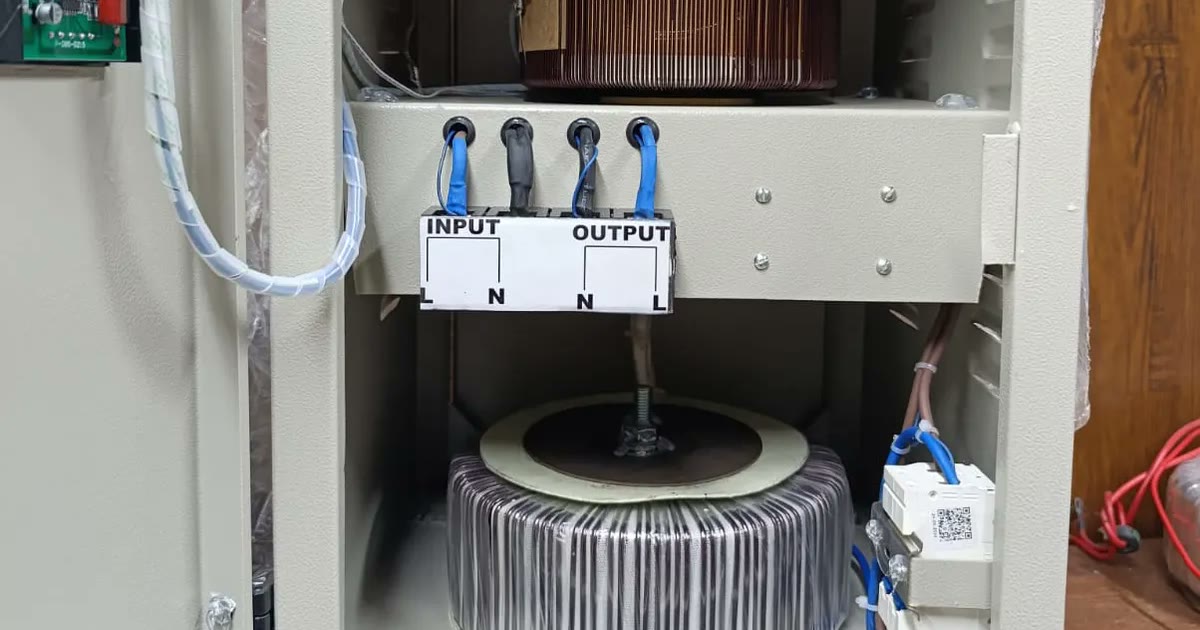
Inside the cabinet is a round copper winding with a bare track on top. A carbon brush presses on that track. A small motor and gearbox move the brush to raise or lower the voltage.
In Pakistan, the voltage moves all day — up at night, down in the evening, swinging every time a big load starts nearby. Each swing means the brush slides along the track. That is thousands of movements a month. Add 45°C summers and dust, and the moving parts wear faster than they would in a clean, cool room.
Problem 1: Worn carbon brush
Signs: output flickers or jumps, a burning smell, black carbon dust inside the cabinet, lights that flicker even though the input reading looks steady.
Cause: the brush has worn down until the spring can no longer press it firmly onto the track. It starts to arc.
Fix: replace the brush and clean the track. If the track has burn marks or grooves, the winding may need resurfacing or replacement — a bigger job.
Problem 2: Motor noise, grinding, or no movement
Signs: a grinding or whining sound, or the output stays stuck at one value while the input changes.
Cause: worn gears, a dry bearing, a failed motor, or a stuck limit switch at the end of the track.
Fix: replace the motor or gearbox. Check the limit switches while the cabinet is open.
Problem 3: The output swings up and down ("hunting")
Signs: the output reading moves up and down by itself, and you hear the motor going back and forth.
Cause: the control card is set too sensitive, the brush is worn, or a feedback wire is loose.
Fix: recalibrate the control card, tighten connections, and check the brush.
Problem 4: Slow to catch a sudden drop
Signs: lights dim for a moment, or a computer, laser or medical machine resets, when the voltage drops suddenly — even though the stabilizer is working.
Cause: this is not a fault. It is how a servo works. A motor can only turn so fast — our servo units correct at about 25–30 volts per second. A sudden 60V drop takes about two seconds to fix.
Fix: there is no repair for physics. If your equipment is sensitive to those two seconds, it needs a solid-state stabilizer, which reacts in milliseconds. See SCR vs servo.
Problem 5: It keeps cutting off
Signs: the stabilizer switches off and shows high or low voltage, then comes back after a delay.
Cause: usually the protection doing its job — your mains has gone outside the range the unit can correct. Sometimes the cut-off is set too tight.
Fix: check the cut-off settings and compare your lowest and highest voltage with the unit's input range. If your area regularly goes outside it, you need a wider-range model.
Problem 6: Overheating
Signs: the cabinet is hot to touch, a thermal trip, or a burnt smell.
Cause: too much load for the kVA, blocked vents, dust, or a unit squeezed into a cupboard.
Fix: add up your load and compare it with the rating. Clean the vents. Give it space. If you have added ACs since you bought it, it may simply be too small. See what size stabilizer you need.
Prevent most of these with simple care
Most of these faults start with dust — from the air, and from the carbon the brush sheds as it wears. A monthly look-and-listen, a clean and brush check every 3–6 months, and a yearly service prevent most of them. Our servo maintenance checklist has the full routine.
Safety first: a stabilizer carries mains voltage inside, and its winding can still be live when the display is off. Switch off at the breaker and isolate it before opening the cabinet. If you are not trained, have a technician do this.
Repair, or move to solid-state?
Repair when: the unit is only a few years old, the problem is the brush or a loose connection, and it runs ordinary home appliances.
Move to solid-state when:
- the winding track is burnt or grooved;
- you are changing brushes every season;
- sensitive equipment keeps resetting on voltage dips;
- the hum is a problem in a clinic, office or bedroom;
- you want something you never have to open.
A solid-state stabilizer has no brush, no motor and no gears — nothing that wears each time it corrects. An SCR stabilizer is the cost-effective step up; an IGBT stabilizer is the top of the range. Our solid-state guide explains both.